# Gift
{% hint style="info" %}
Connect your [SMS](https://highlightcards.gitbook.io/getting-started/how-to-use-highlightcards/connecting-twilio) and [Email](https://highlightcards.gitbook.io/getting-started/how-to-use-highlightcards/connecting-smtp) services so you can send gift cards
{% endhint %}
{% hint style="info" %}
A **Gift Card** allows clients to see a monetary balance on their card and spend it however they like — all at once or in portions.\
You can top up the card multiple times, and customers can use the balance toward any service or product.
You can issue a gift card directly from the **Clients** section and send it via SMS or email with an installation link.
Additionally, customers can purchase gift cards **online** and gift them to others — perfect for holidays, birthdays, and special occasions.\
\&#xNAN;*(Stripe integration is required for online payments.)*
This is one of the most effective tools for bringing in new customers through gifting.
{% endhint %}
#### How it works
Clients can view their balance directly on the card and spend it either fully or partially.\
Balances can be topped up multiple times, and deductions can be made all at once or in smaller portions—depending on how the client uses the card.
You can issue a Gift Card from the **Clients** section and send it to the customer via SMS or email using their unique installation link.
Gift Cards can also be purchased online. Customers can pay for a card and choose to use it themselves or send it to another person.\
(Requires connecting **Stripe** in the card's settings.)
#### **Example Use Case: Selling Gift Cards with Stripe Payments**
You create a gift card with a balance of **1000 points** (or any amount you choose).\
The client pays you via a one-time Stripe payment, and the remaining balance is automatically added to their card.\
When the client returns, you scan their card, check their remaining balance, provide the service, and deduct the points they used.
Gift cards are also ideal for promotions. For example, a customer purchases a gift certificate for a friend’s birthday, completes the payment, and their friend receives an installation link.\
The recipient installs the card and immediately sees the gifted balance.\
They can then redeem the points for services, such as a manicure or facial massage.
#### Gift Card setup
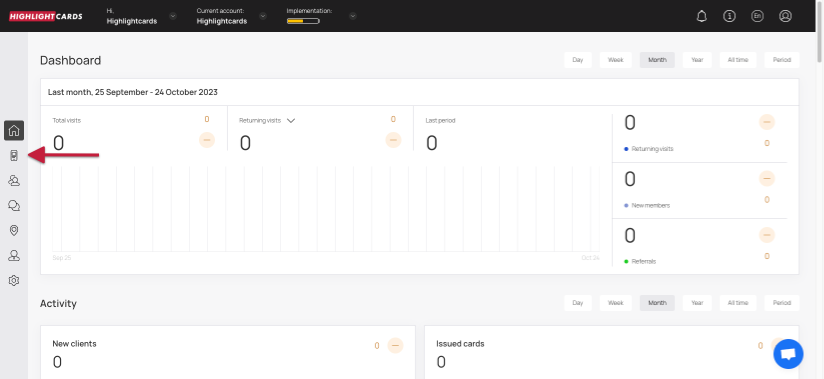
1. Upon successful login, navigate to the left-hand menu.
2. From the list of modules, click the icon. Doing so opens the Cards module.
Cards
3. Here, you can either create a card using a template from a list of a wide range of pre-loaded templates or create one from scratch. To develop a better understanding, we will take a look at card creation from scratch.
4. To do so, click the button.
From Scratch
5. This initiates the card creation workflow. A card is created by filling in the details in 5 sections that include Card Type, Settings, Design, Information, and Save and preview. Let us take a look at how each section works.
#### **Card Type**
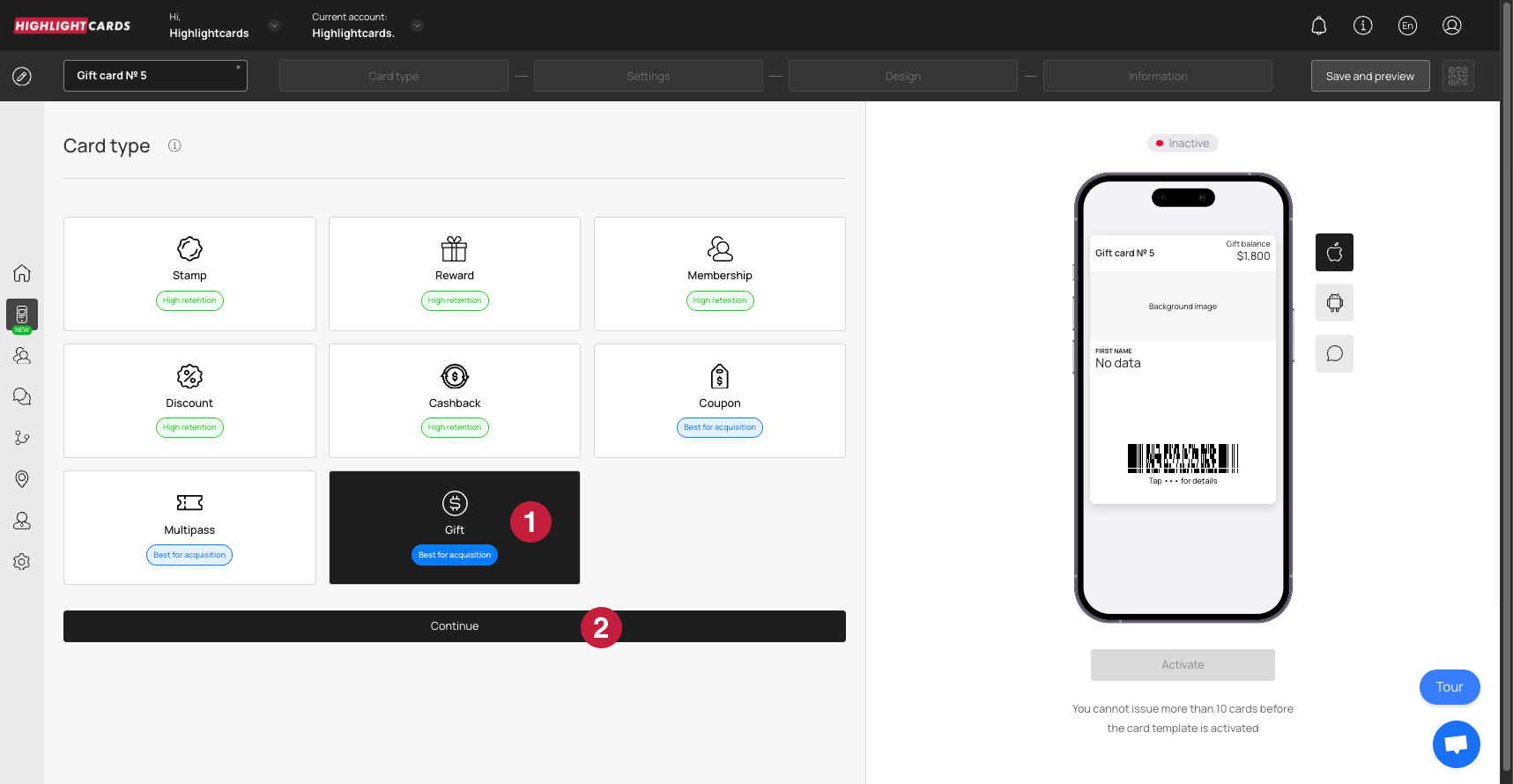
1. This is the first section. Here, you make a selection regarding the type of card you want to create.
2. From the available card types, click **Gift**.
3. Once selected, click the **Continue** button. As a result, you land on the **Settings** section.
Card Type
#### **Settings**
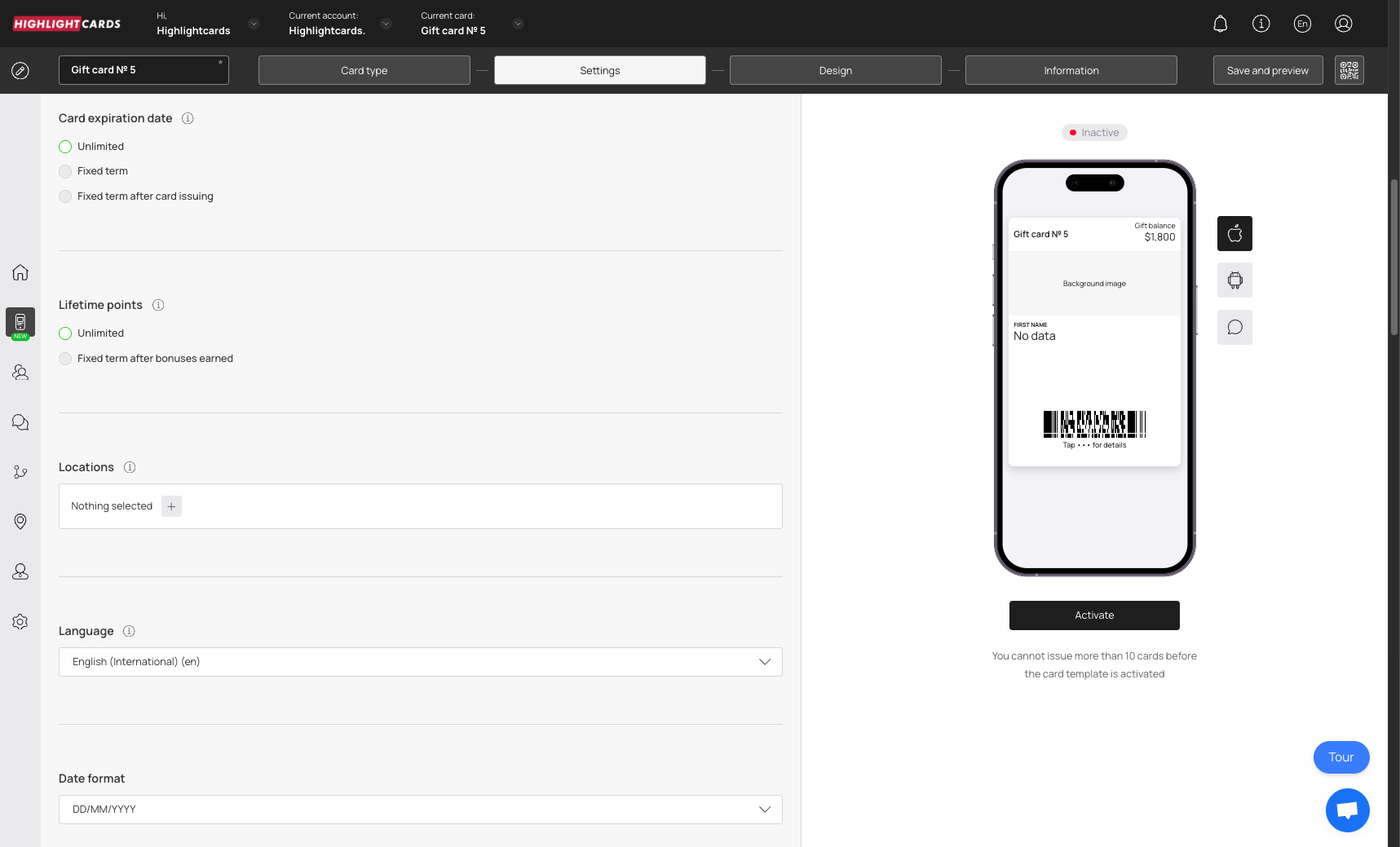
Here, choose the Barcode Type to determine how the card can be scanned and recognized by the system. You can choose the appearance you like.
**Select the redemption rules for gift cards**\
Multiple Use — The balance can be redeemed over several transactions.\
Single Use — The entire balance must be redeemed in one transaction.
To enable online payments via Stripe, connect your Stripe account and enable the “Can be given as a gift” feature.\
If desired, you can set deposit limits. These limits will appear during card issuance.\
Don’t forget to connect SMS and email services so you can send gift cards.
**Card Expiration Date**\
Select the expiration date for the gift card using the radio buttons under the Card Expiration Date heading.
Card expiration date unlimited — The card has no expiration date. The customer can use it indefinitely.\
Card expiration date Fixed term — The card becomes inactive after the selected date. It remains on the phone but cannot be used.\
Card expiration date Fixed term after card issuing — Selecting this reveals Term dropdowns, allowing you to set the number of days after installation until the card expires.
**Lifetime points**\
Lifetime points determine whether loyalty points remain forever or expire after a specific period of time.
**Locations**\
In the Locations field, enter business or non-business addresses where you want to trigger geolocation push notifications.\
Customers with the card installed in Apple Wallet will receive a push when they come within 100 meters of the selected location.\
You can add multiple locations.
**Language**\
Choose the language in which you want to create the gift card.
**Date Format**\
Determines how the date is displayed on the card.\
If the card does not have an expiration date, this setting does not apply.
**Thousands Separator / Decimal Separator**\
Defines how the point balance is shown on the customer’s phone.
**Purchase amount when charging**\
The "Purchase amount when charging" setting, if turned on, requires the purchase amount to be entered whenever a transaction is processed. The entered purchase amount will be counted in ROI statistics, in the revenue figure.\
✅ Applies only to transactions made via the scanner. If this setting is disabled, the purchase amount is optional when using the scanner.
**Card Issuing Form**\
Here, you can define the fields included on the gift card installation form.\
A phone number or email is required.\
You can remove fields using the shopping cart icon.
Enable the "Required" toggle to make a field mandatory.\
Enable the "Unique" toggle for fields that must contain unique values — typically phone numbers.\
Avoid marking fields like “Name” as unique, as it would block customers with the same name.
You can add new fields or rename existing ones. Click Add Field to create a new field and choose the field type and name.
If you want to remove a field, click the bin button. The form must contain at least one field (phone or email).
⚠️ Avoid making Name, Surname and Date of Birth unique — customers with the same name would not be able to install the card.
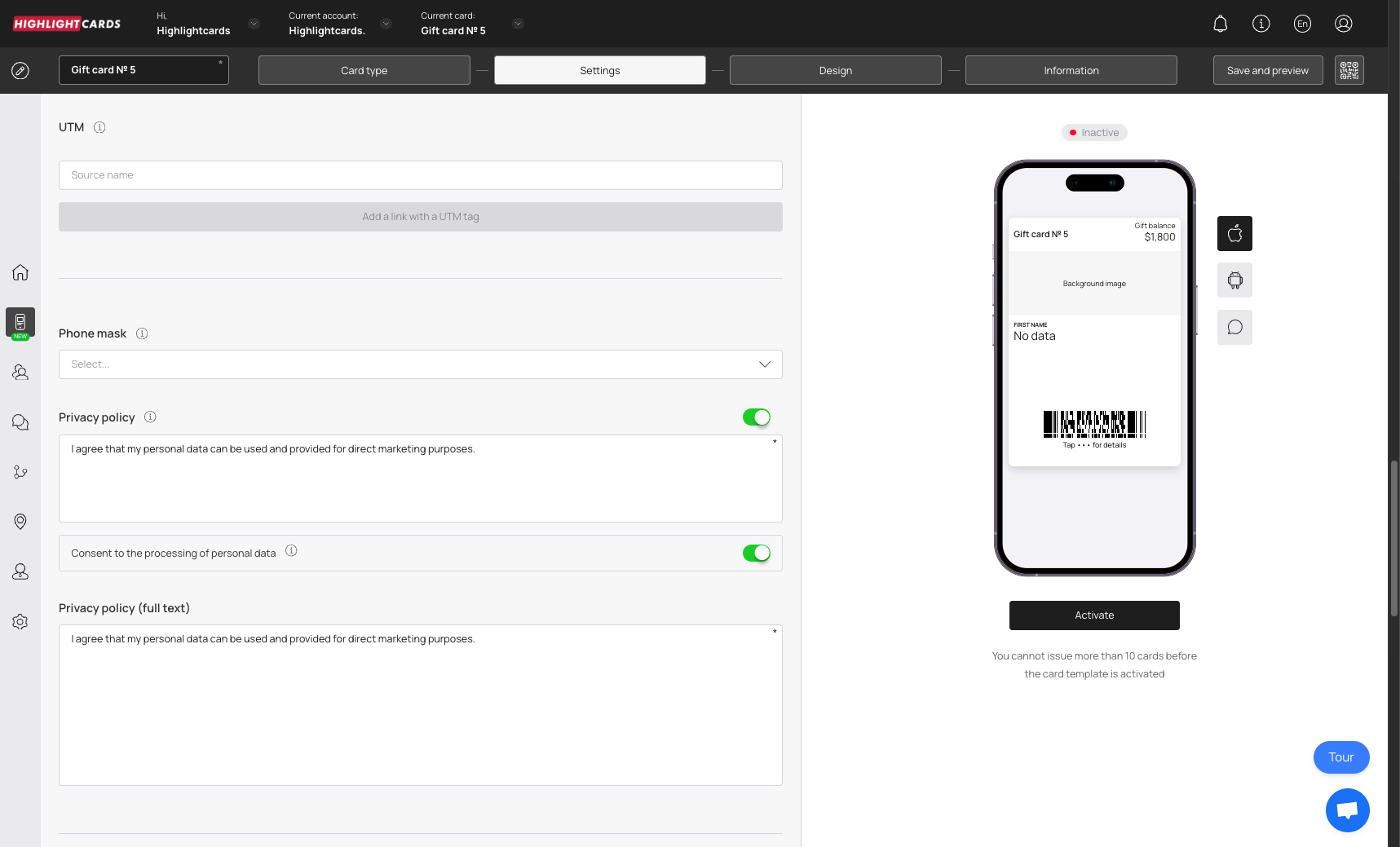
**UTM tag**\
Here, you can create channel links to track which marketing sources generate card installs.\
For example, if you add “Facebook,” Highlightcards will automatically generate a UTM-tagged URL.
You will also see a QR code with the same UTM tag.\
Later, you can view statistics showing how many customers installed the card via that source.
**Phone Mask**\
Select the default country prefix shown in the card installation form.\
Customers can change the region manually if they have a foreign number.
**Privacy Policy**\
Privacy consent is displayed on the card installation form.\
The customer must accept it to install the card.\
You can edit or add text to the privacy policy as needed.
**Card installation options**\
You can choose which installation buttons appear on the card installation form.\
If additional options like Telegram bot are connected to your account, they will appear automatically on the card installation form.
Google Wallet Installation button — If enabled, displays the Google Wallet button on the installation form, allowing customers to add the card to Google Wallet.\
PWA Installation button — If enabled, adds the PWA button, allowing customers to install the loyalty card as a Progressive Web App (behaves like a native app without using an app store).
**Limit the number of cards issued**\
Controls how many cards can be distributed.\
0 means unlimited.
**Number of Points When Issuing a Card**\
Sets the number of points automatically added to the customer’s balance when they install the card.\
Example: If set to 50, every customer who installs the card will see 50 points (as monetary credit) on their balance.
**Number of birthday points**\
On the customer’s birthday, the specified number of points will be added to their balance.\
They will receive a push notification informing them that their balance has increased.
**Analytics**\
If you want to include a custom analytics script, add it to the Analytics field.
Once the required fields are filled, click Continue to proceed to the Design section.
#### **Design**
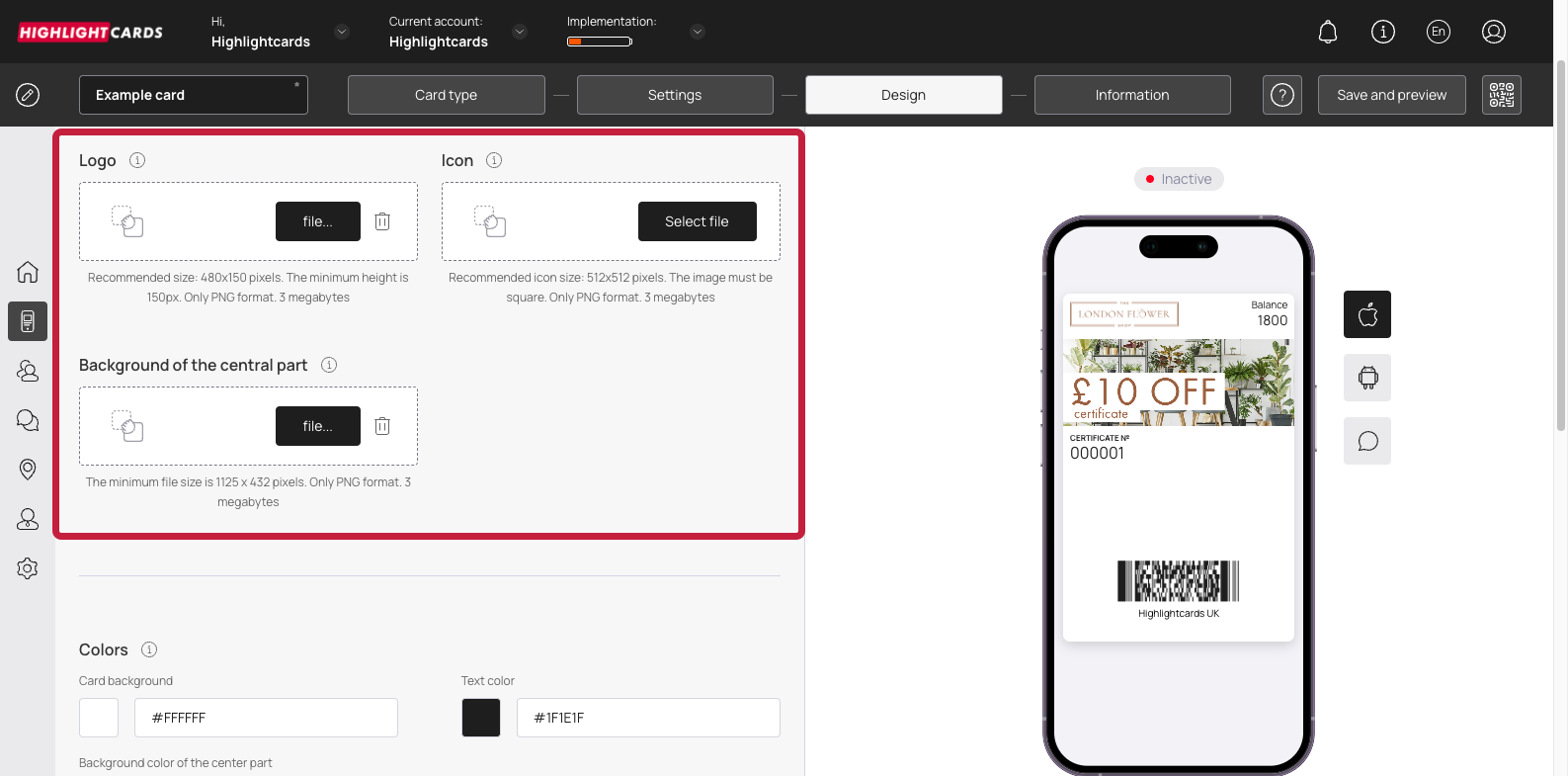
1. This section lets you configure the design of the card.
2. Click the **Select File** button from the **Logo** heading to choose a logo to be displayed on the card and on the release form from your system storage.
Select File - Logo
3. Similarly, click the Select File button from the **Icon** heading to choose an icon from your system storage to be displayed in the push messages.
4. Choose an icon from your system storage for the center of the card by clicking the Select File button under the **Background of the central part** heading.
5. From the Colors section, you can set the colors for Card Background, Text Color, and Background color of the central part.
Colors
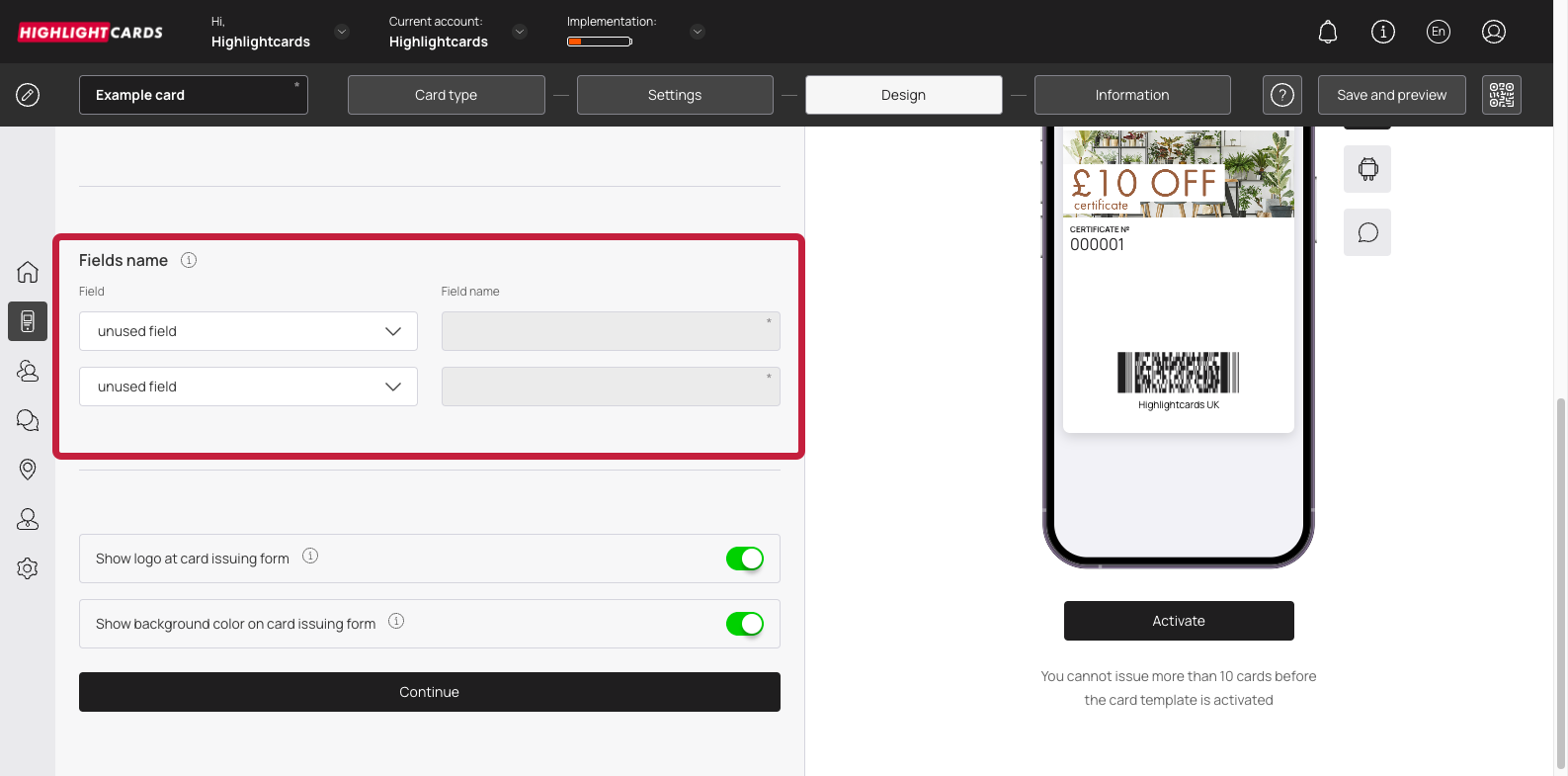
6. From the Fields Name heading, you can use the **Field** dropdown to select the type of field that appears on the card.
Field
7. Similarly, the Field Name field allows you to enter what text appears on the card in the defined field.
8. In case you want the logo to appear on the Card Issuing Form, enable the Show logo at card issuing form toggle button.
9. Similarly, enable the Show background color on card issuing form toggle button in case you want the background color to appear on the card issuing form.
10. Once all the selections are made, click the **Continue** button. You will land on the **Information** section.
#### **Information**
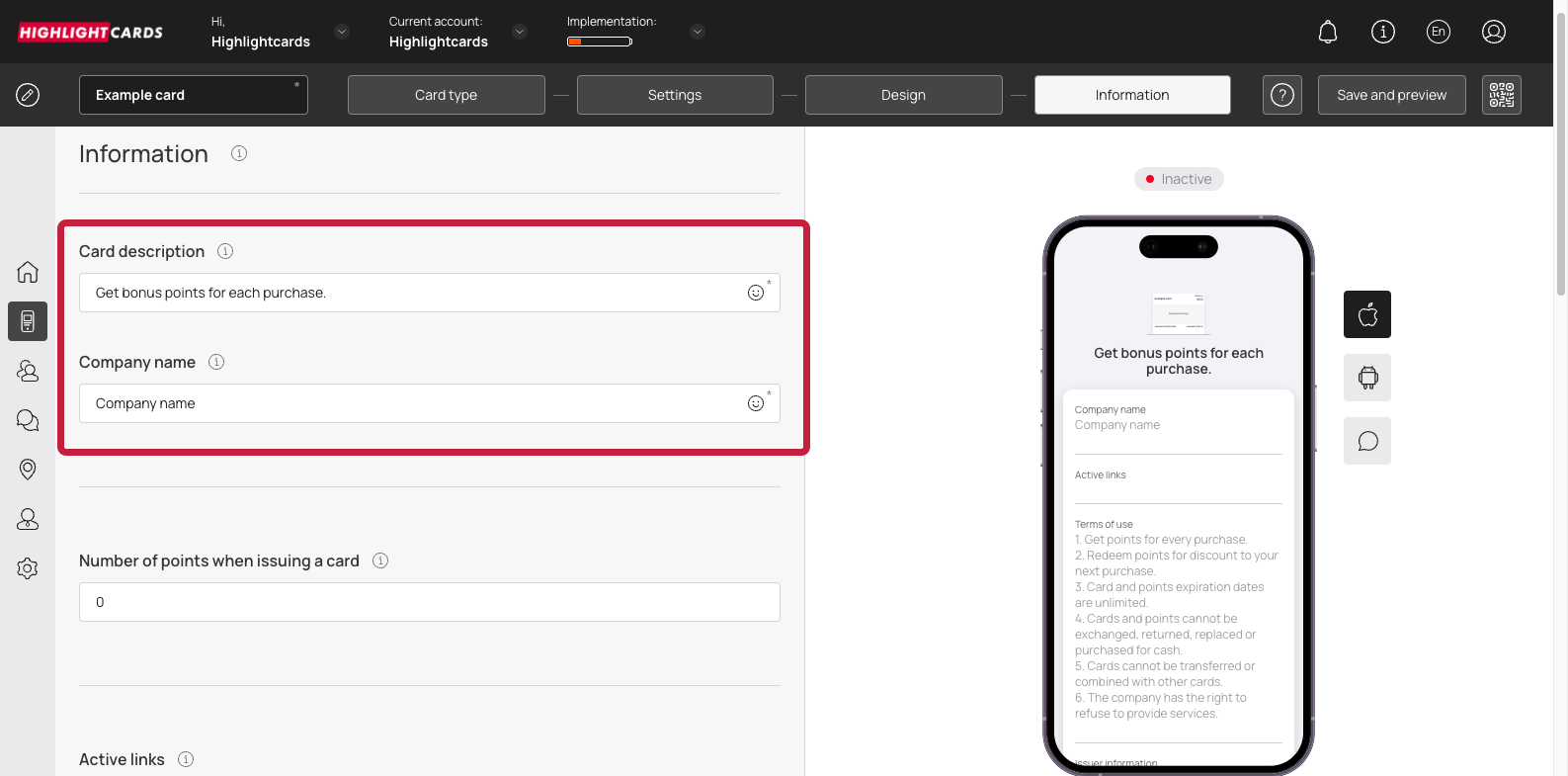
1. This section lets you fill relevant information in the card. The impact of each field can be viewed in the mobile screen preview displayed on the right side of the screen.
2. Use the **Card Description** field to enter the promotion name for the card.
Card Description
3. Use the **Company Name** field to enter the name of your business.
4. Enter the number of points awarded when the card is issued in the **Number of points when issuing a card** field.
Number of points when issuing a card
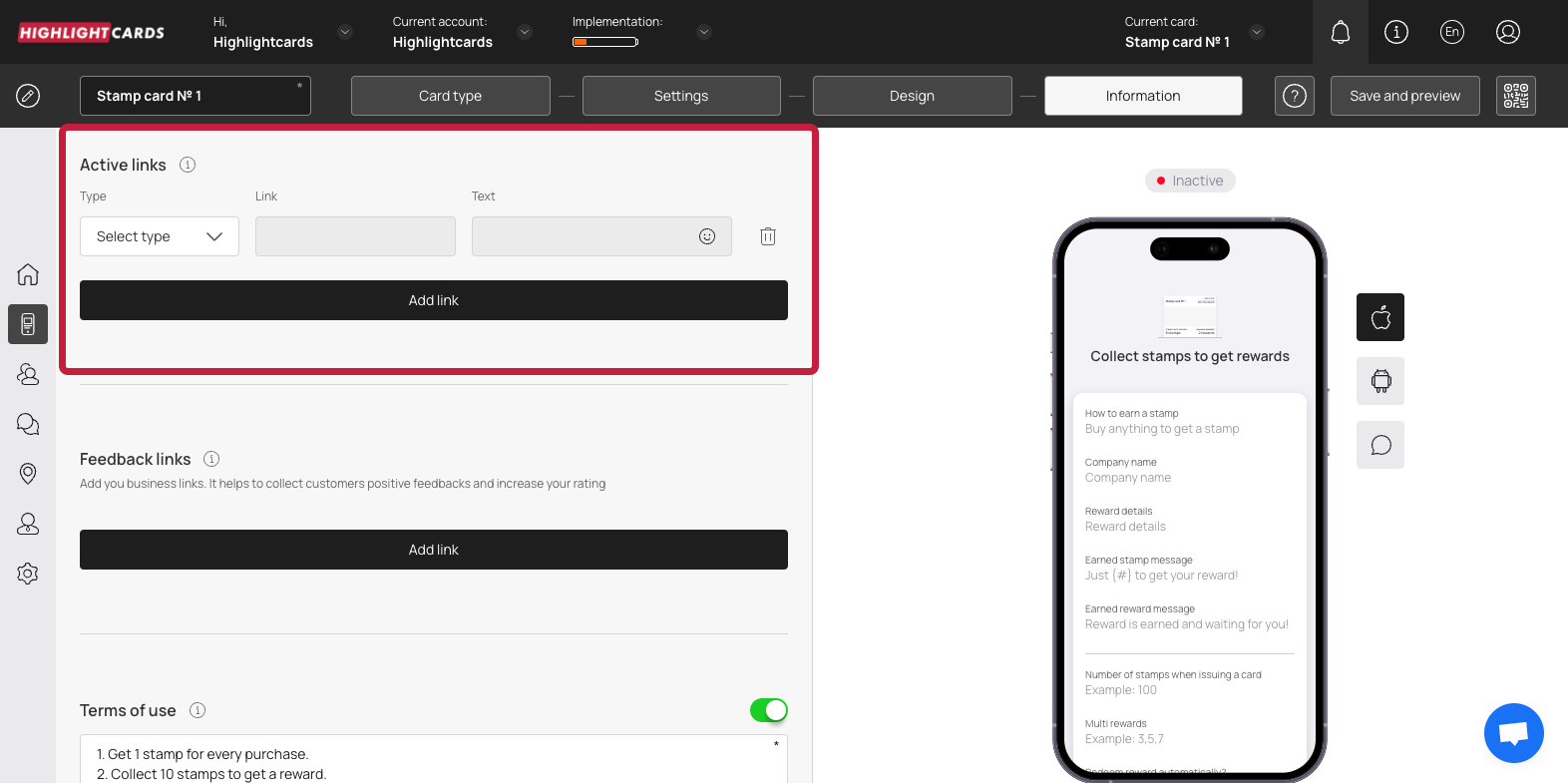
5. From the Active Links heading, choose the type of link you want to include on the card using the **Type** dropdown. The available options include URL, Phone, Email, and Address.
Type
6. Enter the website URL in the **Link** field.
7. Enter the text to appear on the card using the **Text** field.
8. To remove an active link, click the bin button.
9. To add another link, click the **Add Link** button. This adds a new row for another link to be recorded.
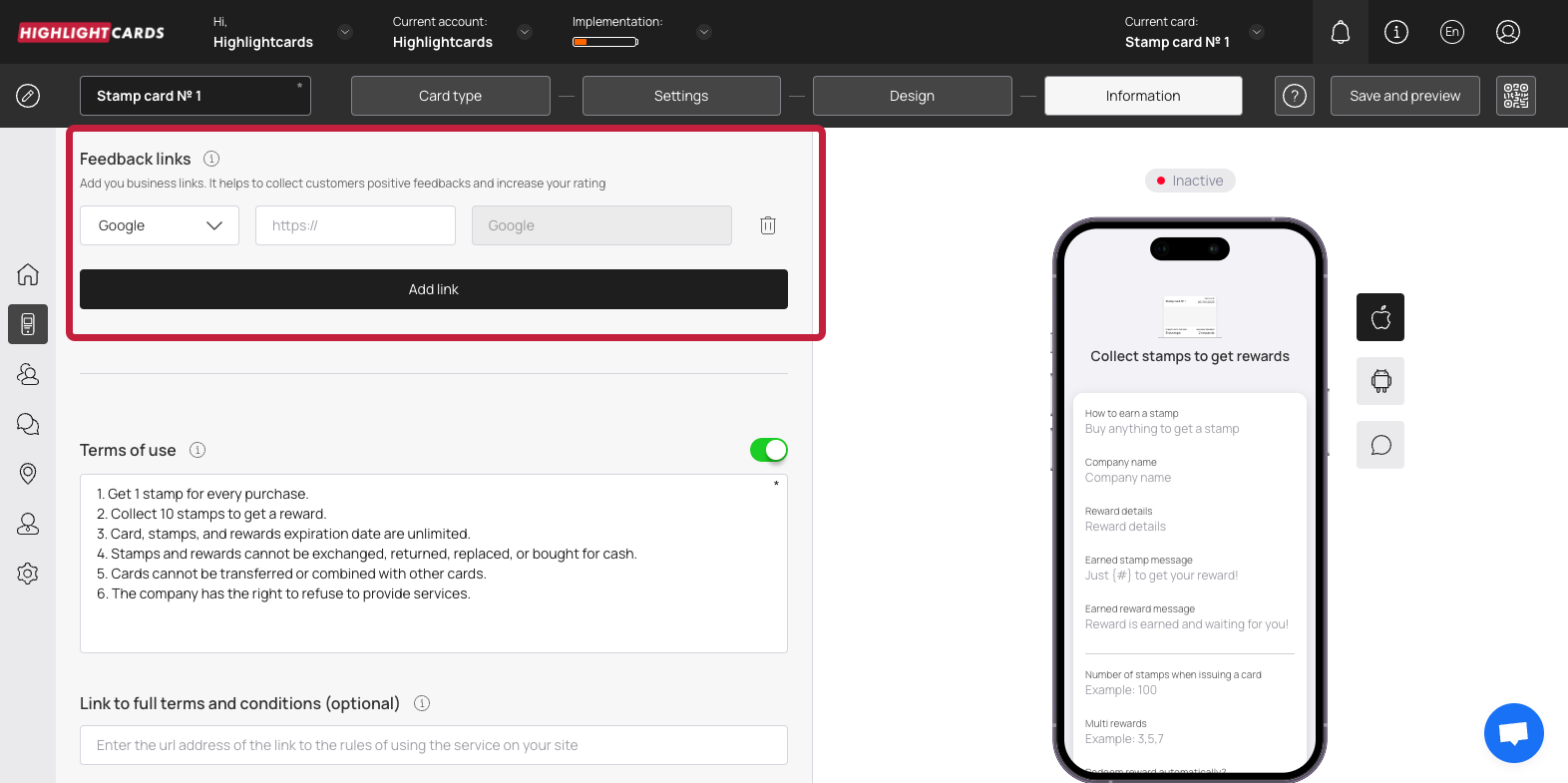
10. Similarly, use the link type dropdown and link fields under the Feedback Links heading to add your business links for the customer reviews to be recorded.
Feedback Links
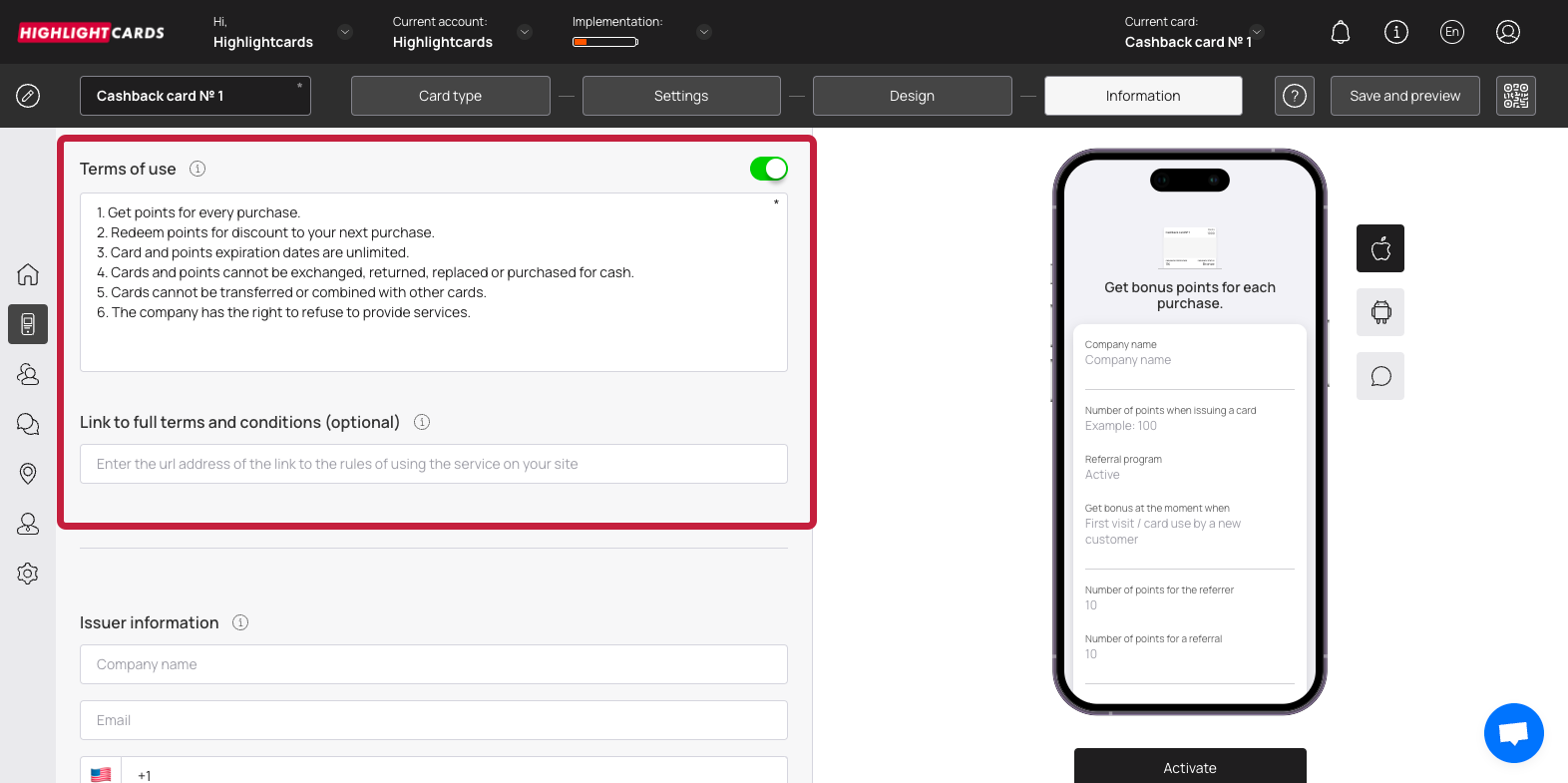
11. In case you want to include Terms of use on the card, enable the toggle button next to Terms of Use heading.
Toggle
12. Enter any terms of use you want to include on the card using the Terms of Use field.
13. Use the Link to full terms and conditions field to provide a link to the complete T\&Cs of your business.
14. Use the Company Name, Email, and Contact Number fields under the Issuer Information heading to record the card issuer details to be displayed at the back of the card.
15. To activate the template, click the **Activate** button under the card preview.
Activate
**Save & Preview**
1. As the Finish button is clicked, the Preview popup is displayed.
2. From here, you can scan the QR code of the card.
3. To copy the link of the car, click the **Copy link** button.
 icon. Doing so opens the Cards module.
 button.


.png?alt=media&token=55a32e49-c45d-4a78-9085-31d93e95da28)
.png?alt=media&token=9a9cca75-5449-4bde-b18c-3714523d65e3)
.png?alt=media&token=f5d6d7c0-9f9a-4121-afc3-18f30edd1d0b)