# Coupon
{% hint style="info" %}
A **Coupon Card** is a powerful way to attract new customers with a one-time offer.\
It can provide:
* a discount
* a complimentary service
* a free product (such as a latte or pastry)
* a first-visit bonus
The customer shows the coupon, you redeem it, and the offer becomes inactive.\
Coupons can also be linked to your main loyalty card — meaning after using the coupon, the customer can automatically begin collecting stamps or points.
Perfect for growing your customer base and encouraging first visits.
{% endhint %}
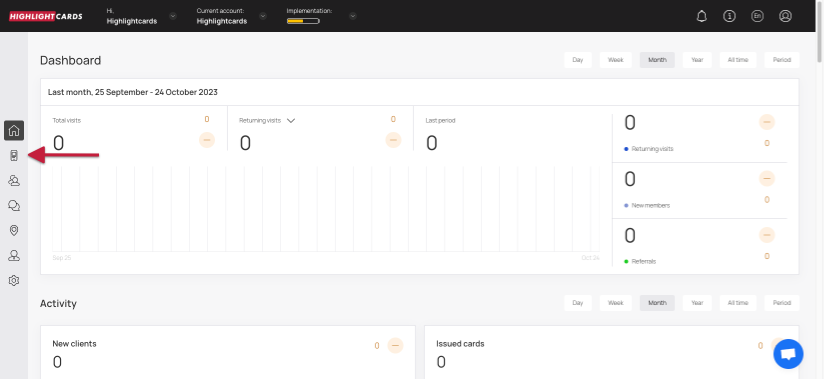
1. Upon successful login, navigate to the left-hand menu.
2. From the list of modules, click the icon. Doing so opens the Cards module.
Cards
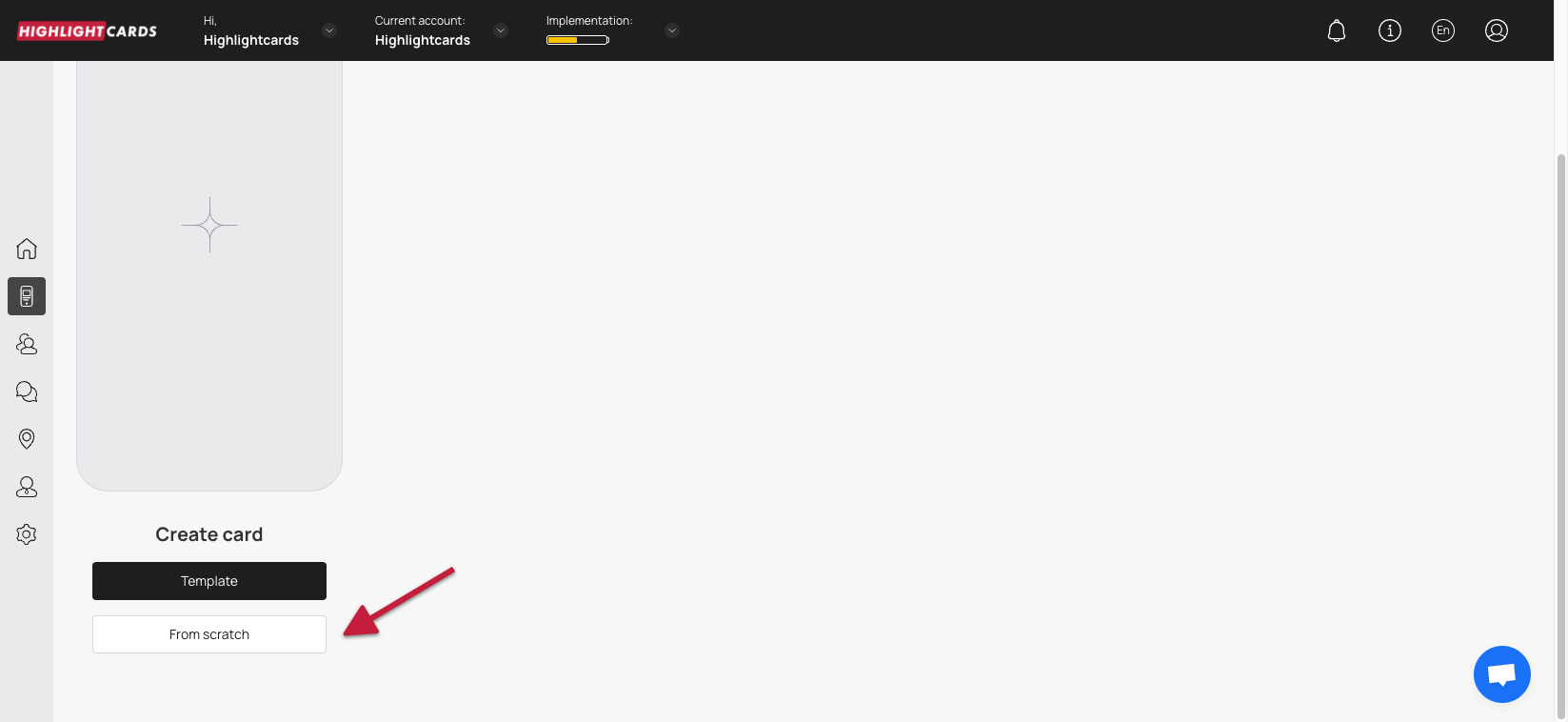
3. Here, you can either create a card using a template from a list of a wide range of pre-loaded templates or create one from scratch. To develop a better understanding, we will take a look at card creation from scratch.
4. To do so, click the button.
From Scratch
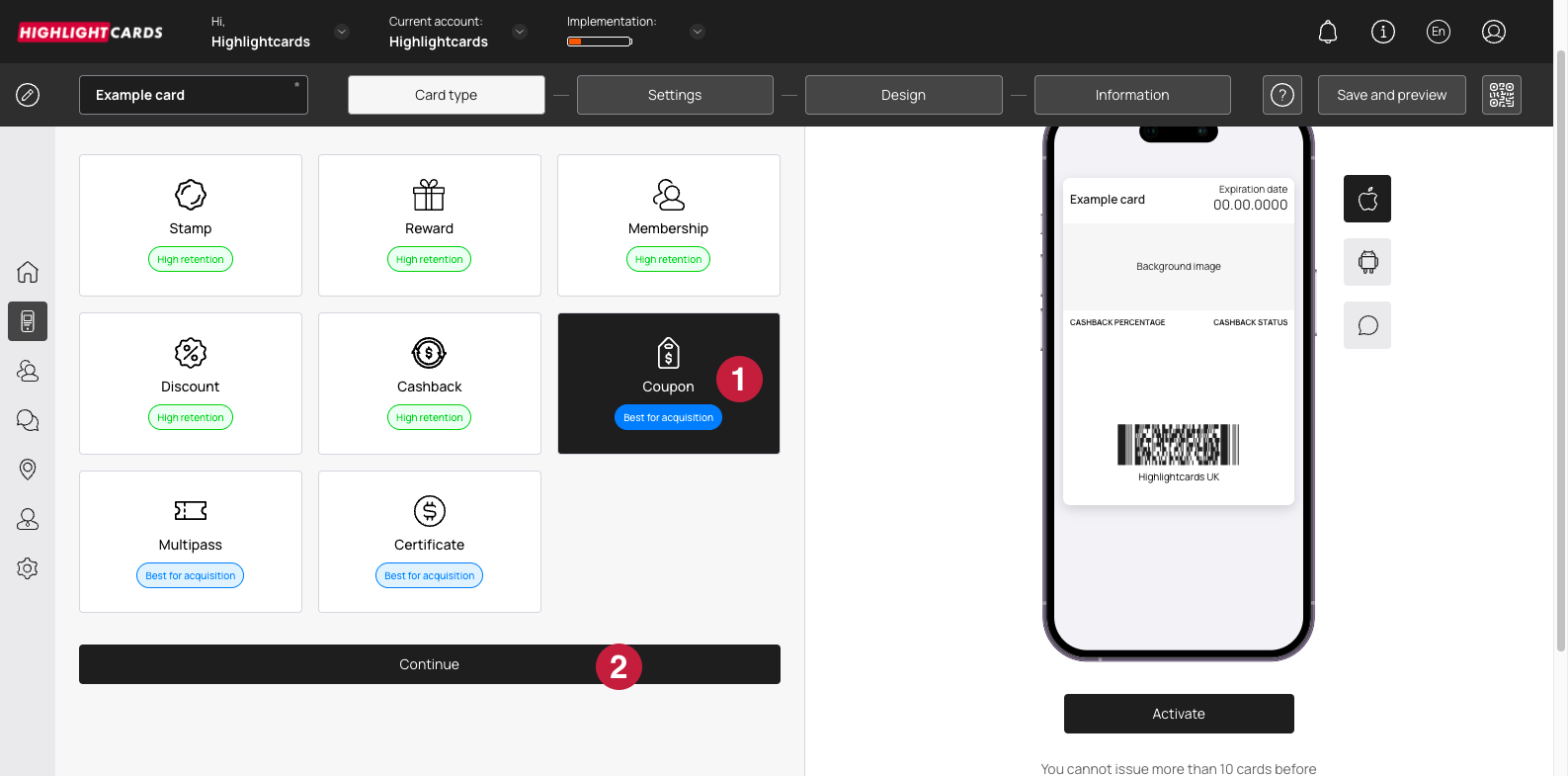
5. This initiates the card creation workflow. A card is created by filling in the details in 5 sections that include Card Type, Settings, Design, Information, and Save and preview. Let us take a look at how each section works.
#### **Card Type**
1. This section lets you choose the type of card you want to create. Since we are creating a coupon card, select **Coupon** from the types available.
2. Once selected, click the **Continue** button. This takes you to the Settings section.
Card Type
#### **Settings**
Here, choose the Barcode Type to determine how the card can be scanned and recognized by the system.
**Card Expiration Date**\
Use the radio buttons under the Card Expiration Date to select how long the card remains valid.\
If you select Fixed term after card issuing, the Term dropdown will appear, allowing you to define the number of days after issuance until the card expires.\
✅ This setting cannot be changed after the card has been activated.
**Locations**\
In the Locations field, enter the address(es) where you want geolocation push notifications to be sent.\
Customers with the card installed in Apple Wallet will receive a push when they are within 100 meters of the location.\
You can add multiple locations, including non-business addresses.
**Linked Card Template**\
This option allows you to link a coupon to another loyalty card template (stamp card, rewards card, etc.).\
✅ Note: If the customer has already installed the linked card, they will not be able to install the coupon. An error message will appear — this is expected behavior.
**Reward for the first visit**\
Enter the reward the customer receives during their first visit when they use this coupon.
**Language**\
Choose the language in which you want to create the coupon card.
**Date Format**\
Determines how dates are displayed on the card.\
If the coupon does not have an expiration date, this setting is irrelevant.
**Thousands Separator / Decimal Separator**\
This setting is not relevant for coupon cards, because coupons do not use points.\
It is used in other card types that display numeric balances.\
✅ For this card type, you can skip this setting.
**Purchase amount when charging**\
The "Purchase amount when charging" setting, if turned on, requires the purchase amount to be entered whenever a transaction is processed. The entered amount will be included in the ROI statistics and revenue totals.
**Card Issuing Form**\
Select the type of field you want to include from the Field Type dropdown.\
Enter the field name in the Field Name field.\
Enable *Required* if the customer must fill out this field.\
Enable *Unique* if the field must contain unique values (recommended only for phone numbers).\
Click Add Field to create additional form fields.
⚠️ Avoid making Name, Surname and Date of Birth unique — customers with the same name would not be able to install the card.
**UTM**\
Here, you can create a channel link to track how customers reach your coupon card.\
For example, entering “Facebook” will make Highlightcards generate a UTM-tagged URL automatically.
You can create unlimited UTM-tagged links.\
Each link generates a UTM tag and a QR code.\
Later, statistics will show how many customers installed the card through each tag.
**Phone Mask**\
Use the Phone Mask dropdown to set the default phone number region in the card installation form.\
Customers can change the region manually if needed.
**Privacy Policy**\
If enabled, the privacy policy text appears on the card installation form.\
You can edit the privacy policy in the field provided.\
Enable Consent to the processing of personal data if you need to request explicit customer approval for data handling.
**Google Wallet Installation button**\
If enabled, customers will see a Google Wallet button during installation, allowing them to save the card directly to Google Wallet.
**PWA Installation button**\
If enabled, customers can install the loyalty card as a Progressive Web App (PWA), which behaves like a mobile app without requiring an app-store download.
**Limit the number of cards issued**\
Controls how many coupon cards can be distributed.\
0 means unlimited.
**Analytics**\
If you want to include a custom analytics script, paste it into the Analytics field.
Once the required details are added, click Continue to proceed to the Design section.
#### **Design**
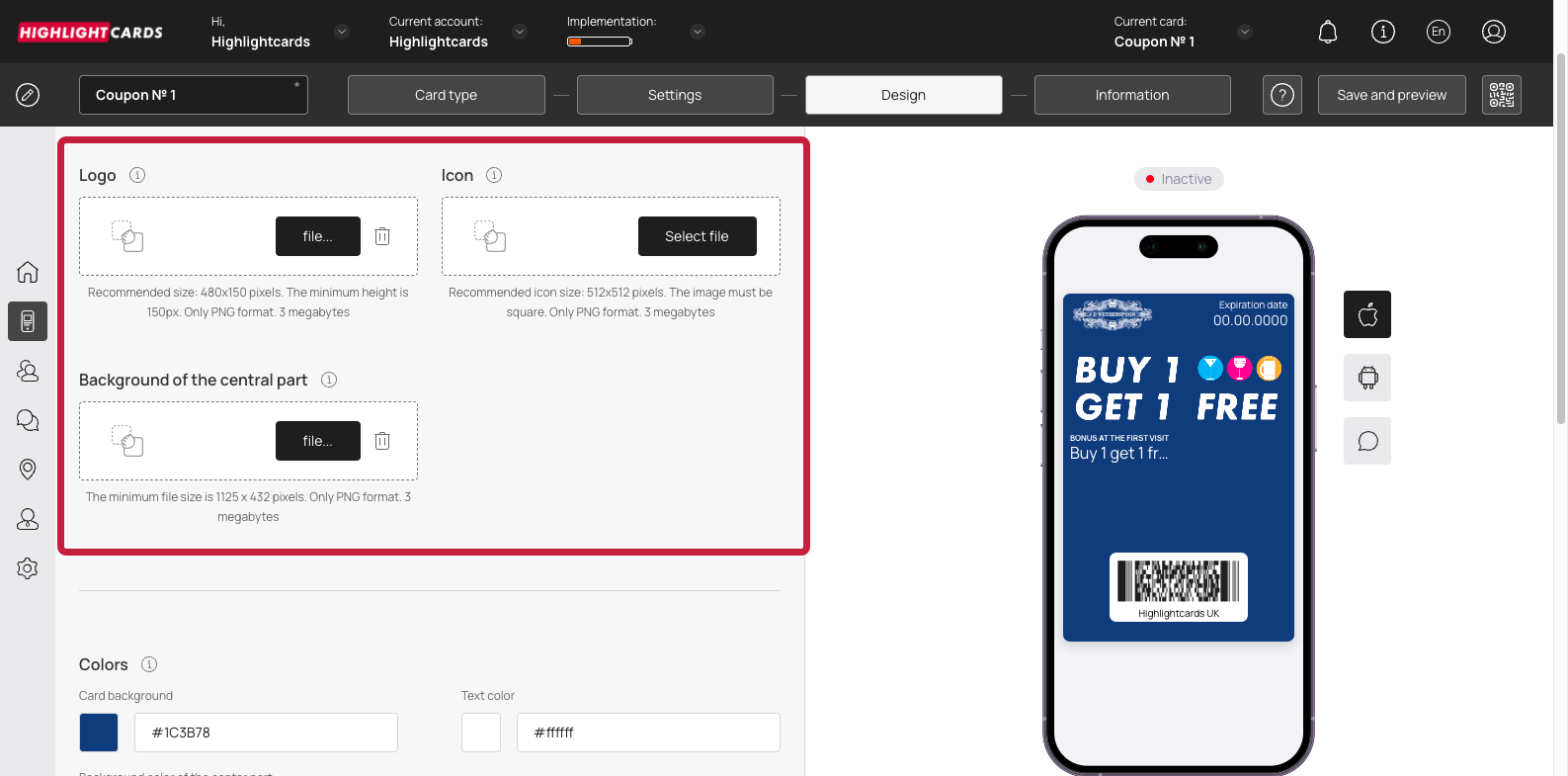
1. This section lets you configure the design of the card.
2. Click the **Select File** button from the **Logo** heading to choose a logo to be displayed on the card and on the release form from your system storage.
Select File - Logo
3. Similarly, click the Select File button from the **Icon** heading to choose an icon from your system storage to be displayed in the push messages.
4. Choose an icon from your system storage for the center of the card by clicking the Select File button under the **Background of the central part** heading.
5. From the Colors section, you can set the colors for Card Background, Text Color, and Background color of the central part.
Colors
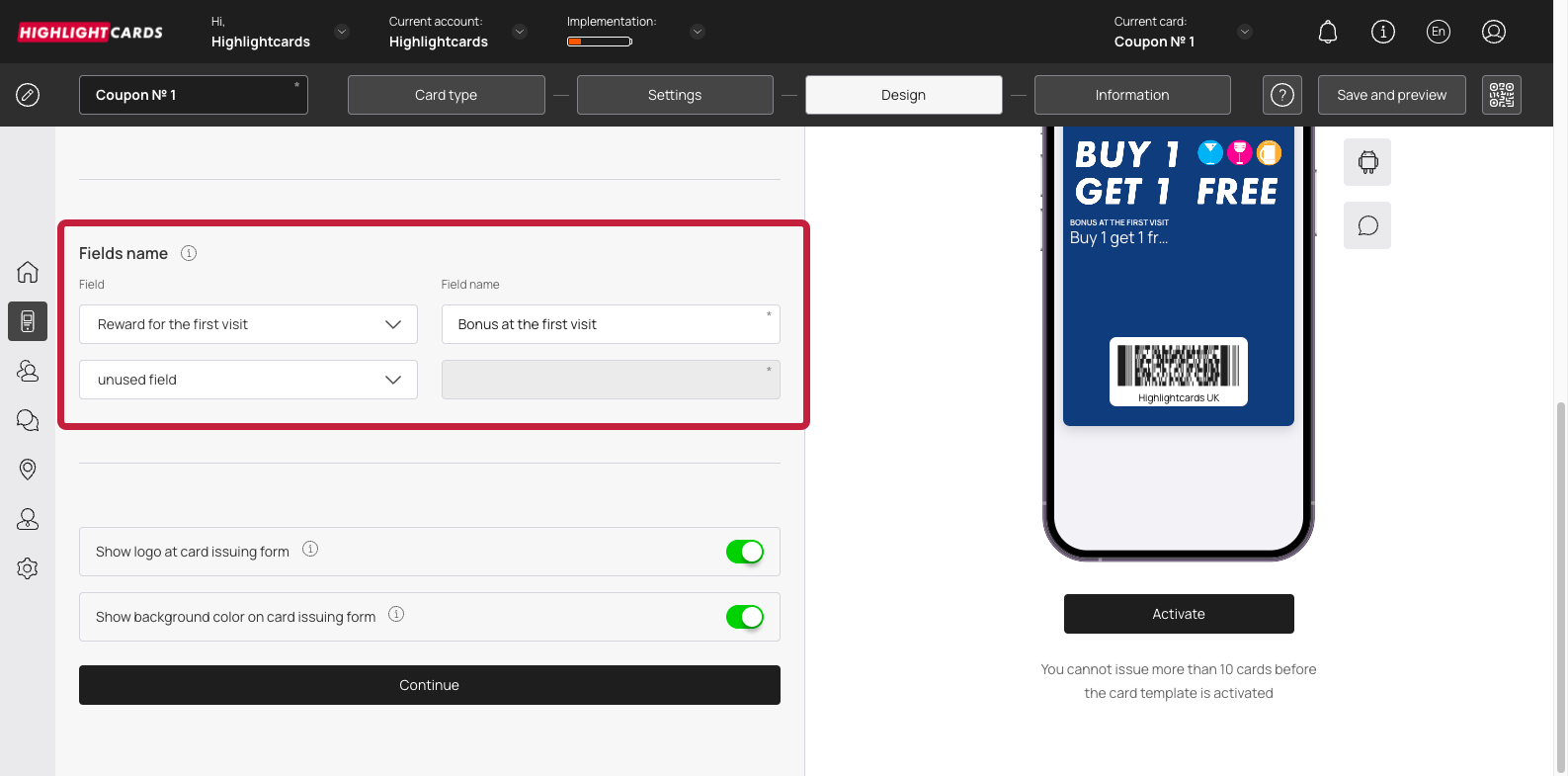
6. From the Fields Name heading, you can use the **Field** dropdown to select the type of field that appears on the card.
Field
7. Similarly, the Field Name field allows you to enter what text appears on the card in the defined field.
8. In case you want the logo to appear on the Card Issuing Form, enable the Show logo at card issuing form toggle button.
9. Similarly, enable the Show background color on card issuing form toggle button in case you want the background color to appear on the card issuing form.
10. Once all the selections are made, click the **Continue** button. Resultantly, you land on the **Information** section.
#### **Information**
1. Using this section, you can fill in the relevant information on the coupon card.
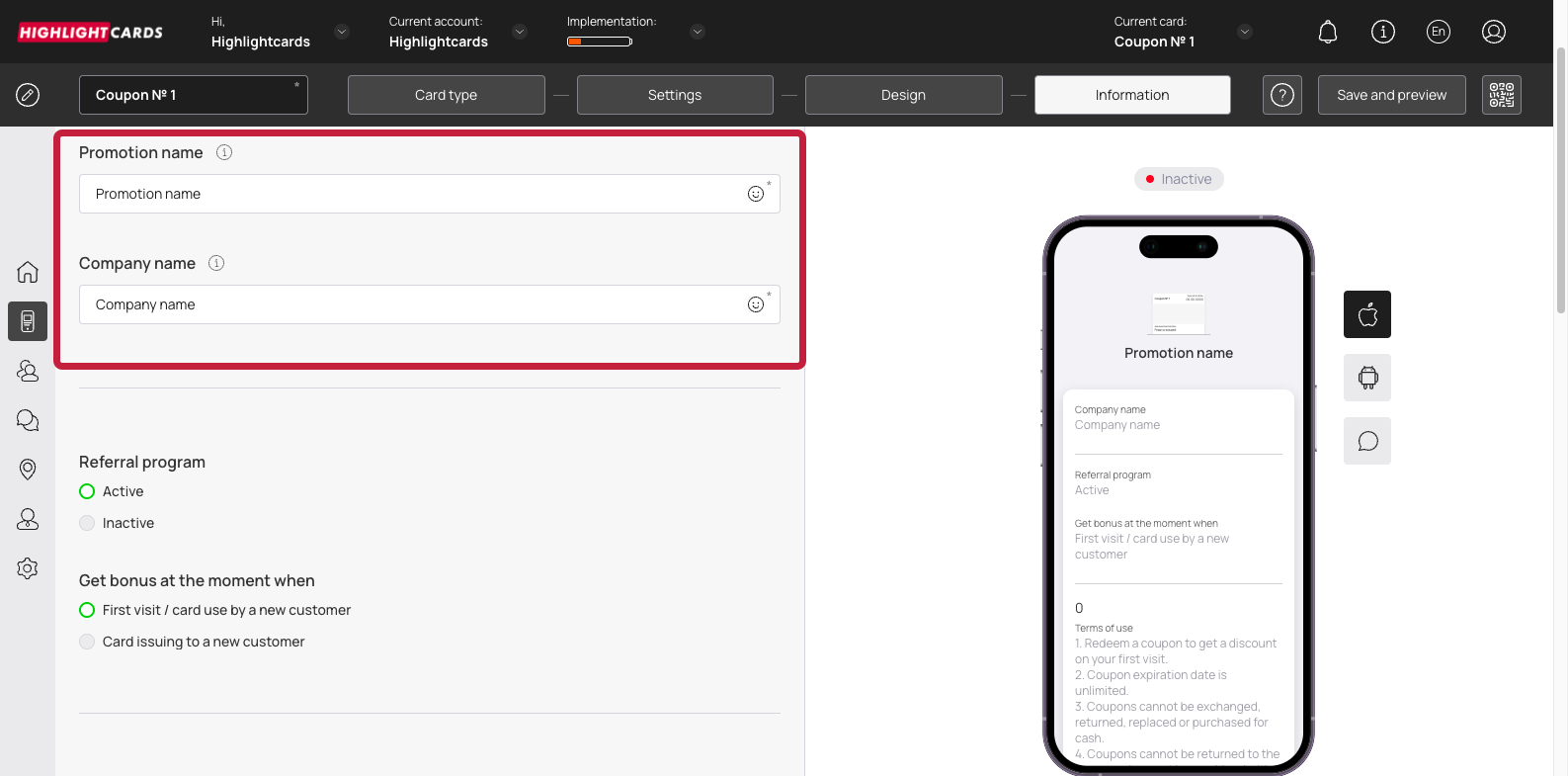
2. To begin, name the promotion you want to offer via the coupon using the Promotion Name field.
Promotion Name
3. Enter the name of your business in the Company Name field.
Company Name
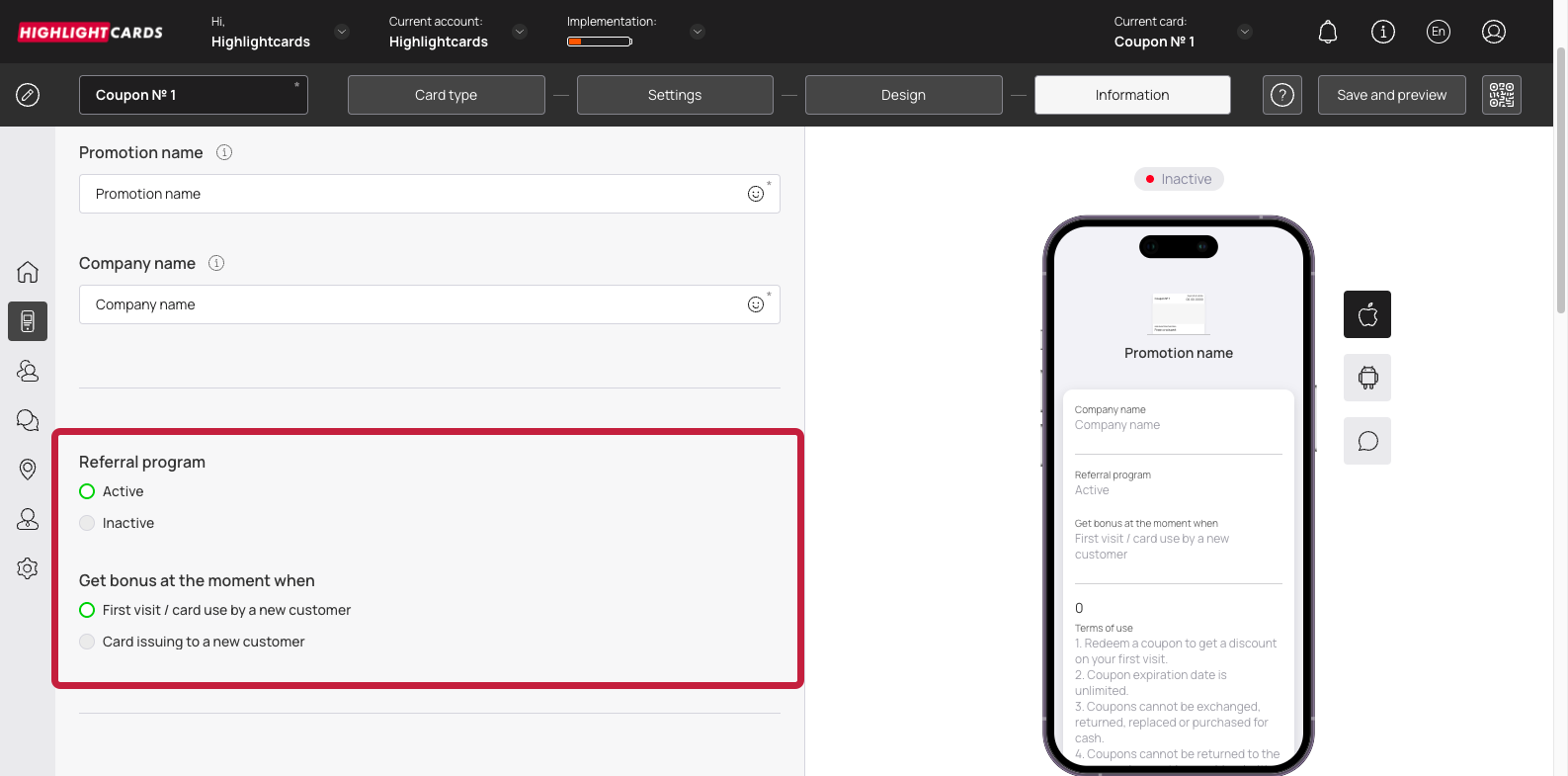
4. In case you want to activate referral program on the coupon card, choose the Active radio button under the **Referral Program**.
5. This reveals the **Get bonus at the moment when** heading. Here, you can select when the bonus is awarded to the referrer.
6. Define when the bonus is issued to a customer from the options available under the **Get bonus at the moment when** .
7. Choose the number of points a customer earns upon sharing their card via the referral program using the **Number of points for the referrer** heading.
8. Similarly, choose the number of points a new customer earns upon registering via the referral program using the count icons under the **Number of points for a referral** field.
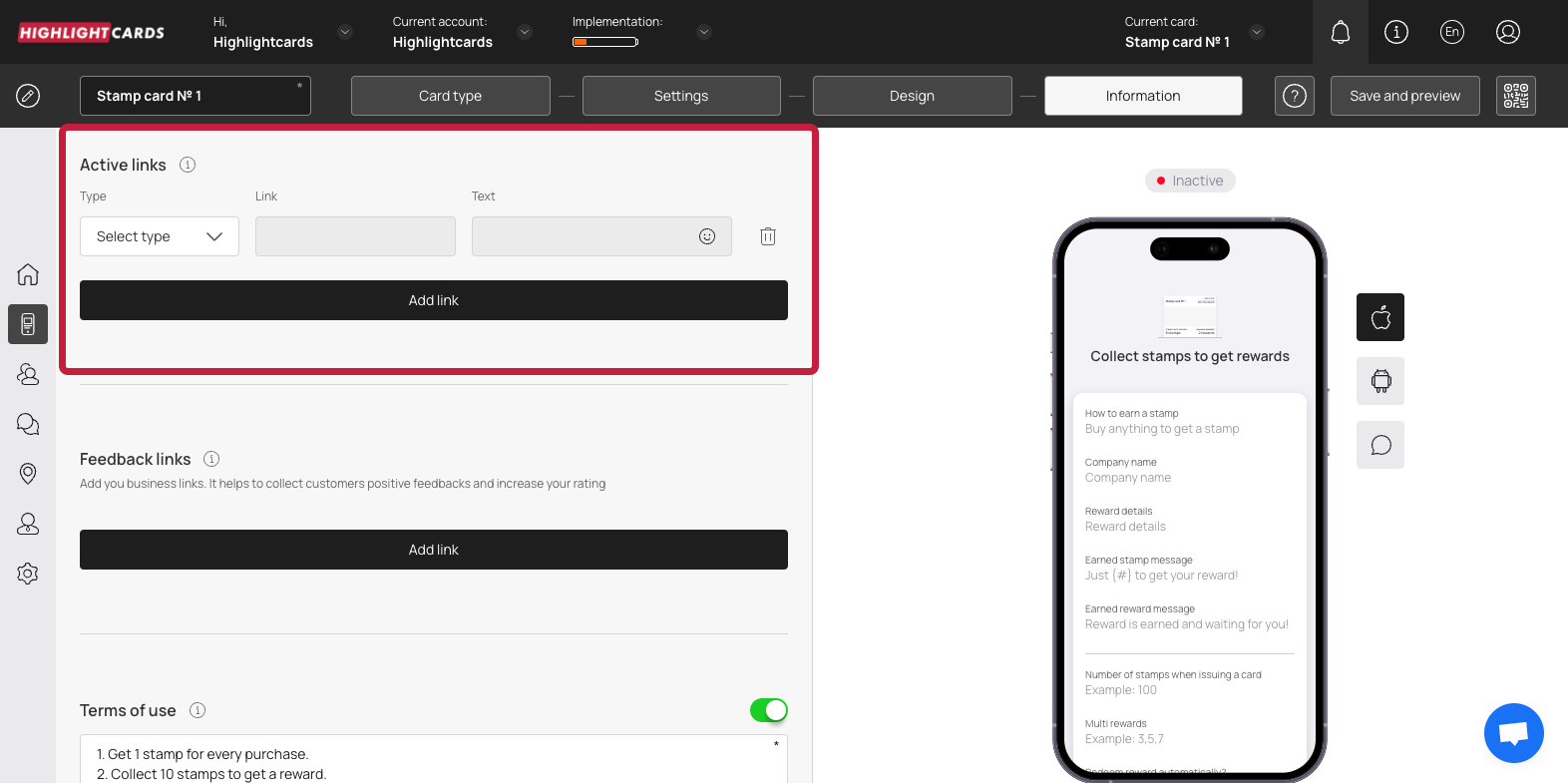
9. From the Active Links heading, choose the type of link you want to include on the card using the **Type** dropdown. The available options include URL, Phone, Email, and Address.
Type
14. Enter the website URL in the **Link** field.
15. Enter the text to appear on the card using the **Text** field.
16. To remove an active link, click the bin button.
17. To add another link, click the **Add Link** button. This adds a new row for another link to be recorded.
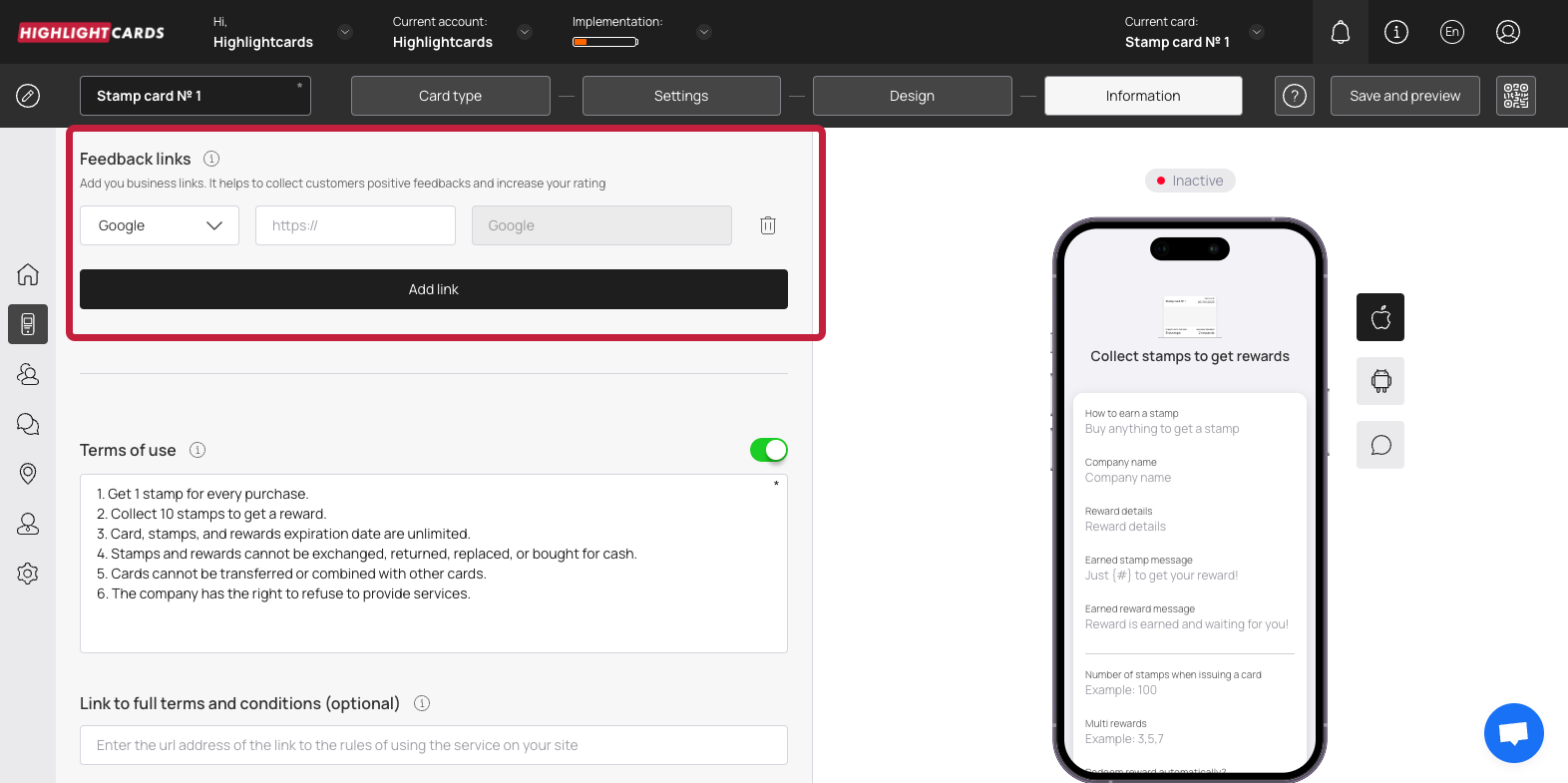
18. Similarly, use the link type dropdown and link fields under the Feedback Links heading to add your business links for the customer reviews to be recorded.
Feedback Links
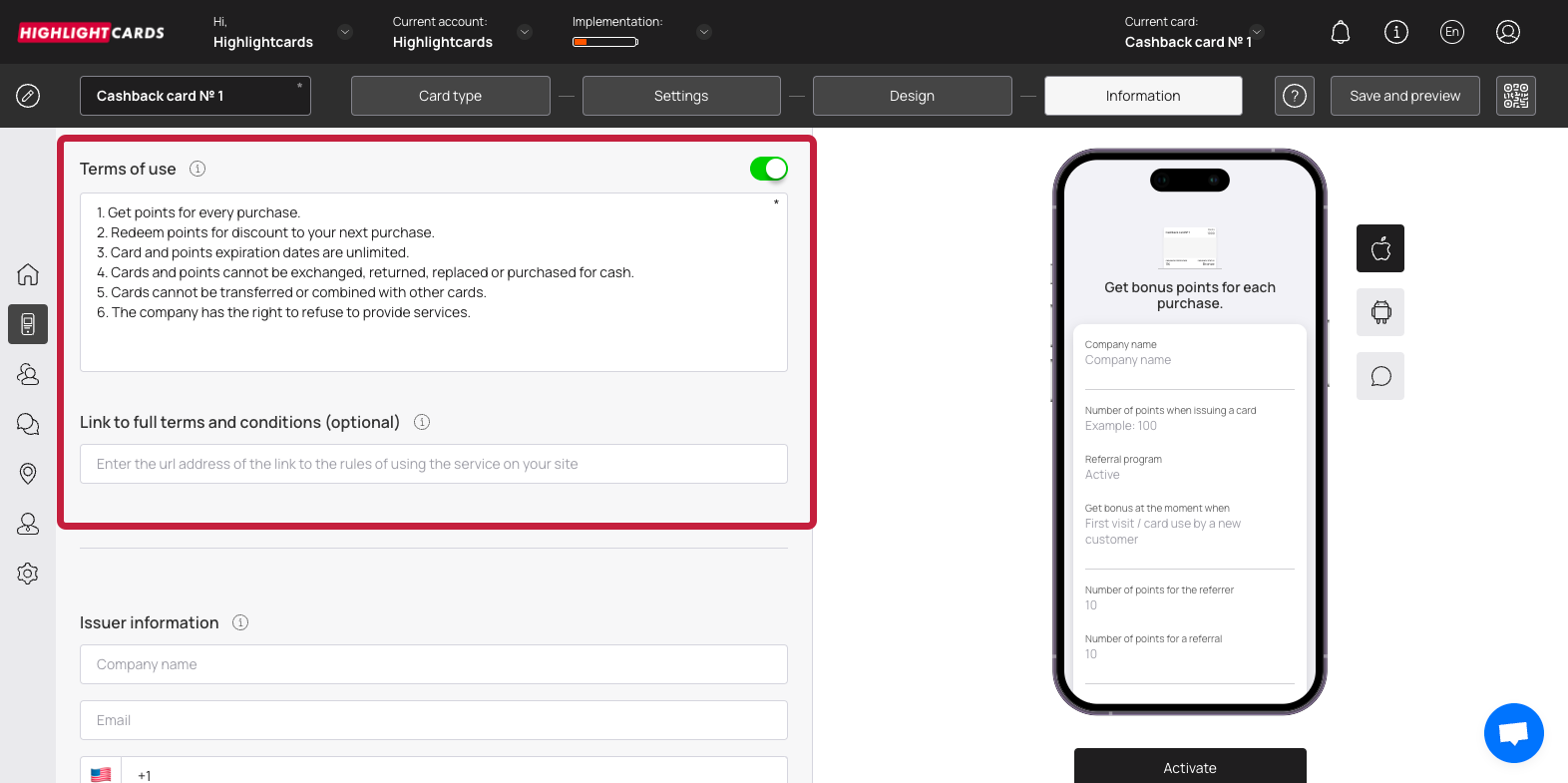
19. In case you want to include Terms of use on the card, enable the toggle button next to Terms of Use heading.
Toggle
20. Enter any terms of use you want to include on the card using the Terms of Use field.
21. Use the Link to full terms and conditions field to provide a link to the complete T\&Cs of your business.
22. Use the Company Name, Email, and Contact Number fields under the Issuer Information heading to record the card issuer details to be displayed at the back of the card.
23. To activate the template, click the **Activate** button under the card preview.
Activate
**Save & Preview**
1. As the Finish button is clicked, the Preview popup is displayed.
2. From here, you can scan the QR code of the card.
3. To copy the link of the car, click the **Copy link** button.
 icon. Doing so opens the Cards module.
 button.


.png?alt=media&token=bc4a648c-592d-45f8-8b98-560b2bfe5a42)

.png?alt=media&token=1a504dfa-5ea7-4345-a7f9-55e6bcb083f4)